The Complete Guide to Buying a Quadruped Robot in South Africa (2026)
Choosing your first quadruped robot is a big decision. This 2026 buyer's guide walks through every Unitree model available in South Africa — Go2, B2, A2, Go2-W and B2-W — with honest comparisons, total cost of ownership, and how to avoid the traps of importing one yourself.
Buying your first quadruped robot is the kind of decision that gets easier the more you know. The headline price is rarely the full story. Total cost of ownership, warranty cover, software support, integration time, and the cost of getting it wrong all matter — sometimes more than the sticker price itself.
This guide walks through every Unitree quadruped model currently available in South Africa in 2026, explains what each one is genuinely good at, and helps you avoid the traps that catch first-time buyers. By the end, you will know exactly which model fits your use case, what you should expect to pay landed in South Africa, and why importing one yourself is usually a more expensive mistake than it looks.
Quick Answer: Which Quadruped Should You Buy?
If you are short on time, here is the one-paragraph version. For research, education, and embodied-AI development, buy the Unitree Go2 AIR. For industrial inspection, security patrol, or anything outdoors, buy the Unitree B2. For payload-heavy industrial work, buy the Unitree A2. For wheeled-leg hybrid use cases where speed matters more than terrain, buy the Unitree Go2-W or B2-W. Now let us look at why.
The Consumer Tier: The Unitree Go2 Family
The Go2 is the most accessible quadruped robot in the world, and the one that put autonomous four-legged robotics within reach of universities, startups, and serious hobbyists. Three variants share the same chassis but differ in computing power, sensor configuration, and price.

Unitree Go2 AIR — From $1,600
The Go2 AIR is where most South African buyers should start. For roughly the price of a high-end mobile workstation, you get an autonomous quadruped with the standard 4D LiDAR L2 sensor (360°×90° field of view), an 8-core high-performance CPU, an HD wide-angle camera, WiFi 6, and a 5 m/s top speed. Battery life is 1-2 hours per charge, which is more than enough for almost any research session.
The AIR is the right choice for educators, students, researchers, robotics clubs, and anyone wanting to learn embodied AI without committing to industrial-grade pricing. It runs the full Unitree SDK, supports continuous OTA updates, and slots neatly into the same software ecosystem as every other Unitree platform.
Unitree Go2 PRO and Unitree Go2 X
The PRO adds upgraded computing for more demanding AI workloads and faster actuator response. The X is the performance flagship of the consumer line, suited to advanced developers who need every available bit of capability inside the consumer pricing tier. Unless you have a specific need that the AIR cannot meet, the AIR is still the right starting point — the PRO and X are best chosen with a concrete workload in mind.
For a deeper look at the Go2 family, read our existing piece: Unitree Go2: The Most Accessible Robot Dog in the World.
The Industrial Tier: The Unitree B2 and B2-W
When the Go2 line is too fragile for sustained outdoor or industrial work, the B2 is where you step up. This is a different class of machine: IP67-rated dust and water protection, an operating temperature range of -20°C to 55°C, and substantially heavier-duty joint motors and gearboxes.
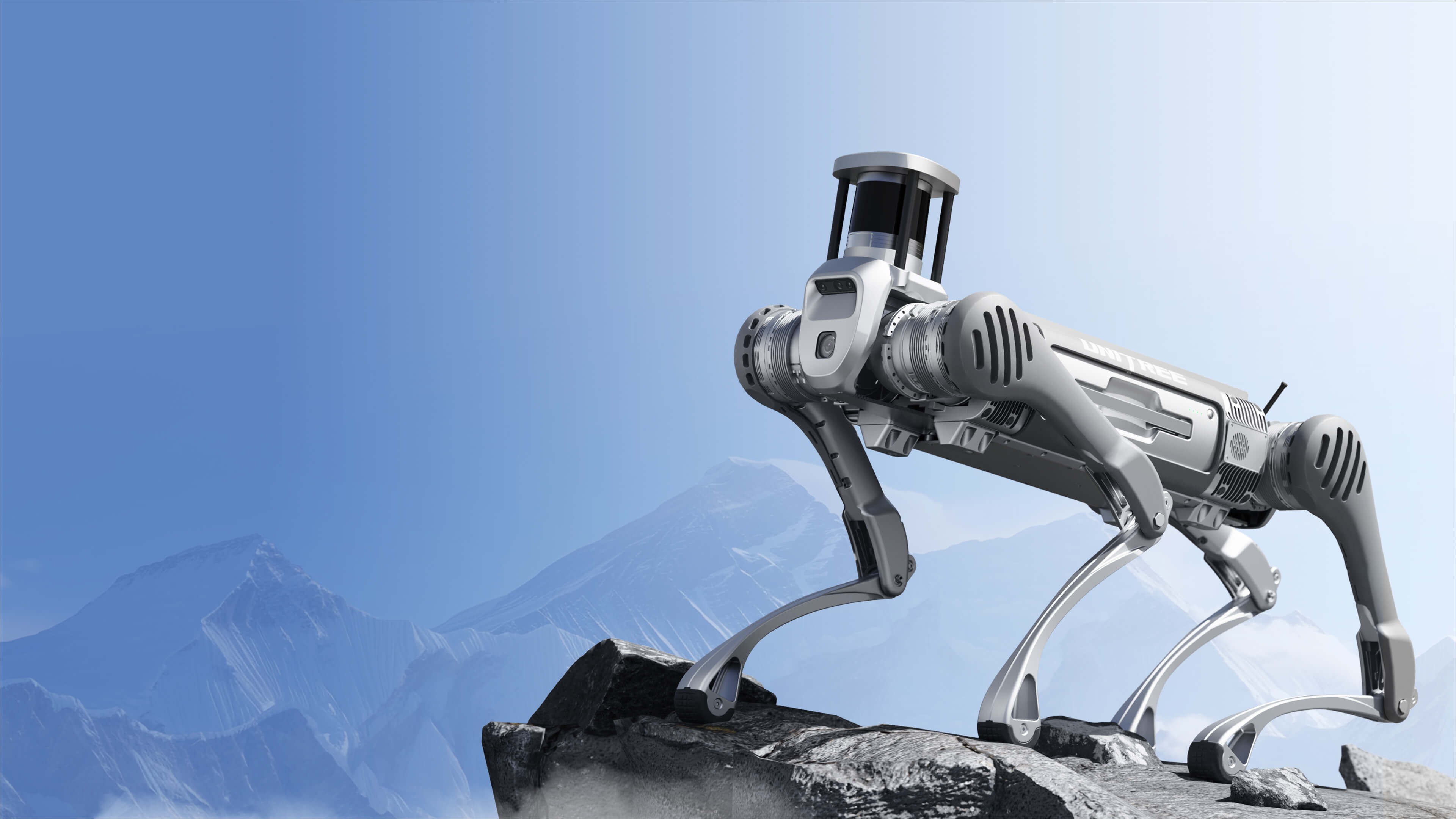
The B2 is the right call for mining inspection, perimeter security patrol, agricultural fieldwork, infrastructure monitoring, and any deployment where the robot will spend serious time outdoors or in dusty, wet, or temperature-extreme conditions. South African mining sites, farms, and security estates fit this profile almost perfectly.
The B2-W replaces the rear feet with wheels, dramatically increasing speed and energy efficiency on flat surfaces while keeping the front legs free for stairs, kerbs, and obstacles. It is the right choice when most of your operating environment is paved, smooth, or factory-floor flat, but you still need true legged capability for the occasional vertical challenge.
The Heavy-Duty Tier: The Unitree A2
The A2 is the heavy-duty industrial quadruped — larger, stronger, and capable of carrying significantly more payload than the B2. It is the right choice for industrial integrators who need to mount substantial sensor packages, robotic arms, or task-specific tooling on a quadruped chassis.

If you are sizing the right platform for a custom autonomous inspection robot, a manipulator-mounted mobile platform, or a heavy-payload field robot, the A2 is the starting point. For pure perimeter patrol or lightweight inspection, the B2 is usually the better fit.
The Wheeled-Leg Hybrid: Unitree Go2-W
The Go2-W is the wheeled variant of the consumer Go2 chassis. Wheels in place of feet give it significantly faster cruise speed and far better battery efficiency on smooth ground. The trade-off is reduced capability on rough or irregular terrain compared to the all-legged Go2 line.
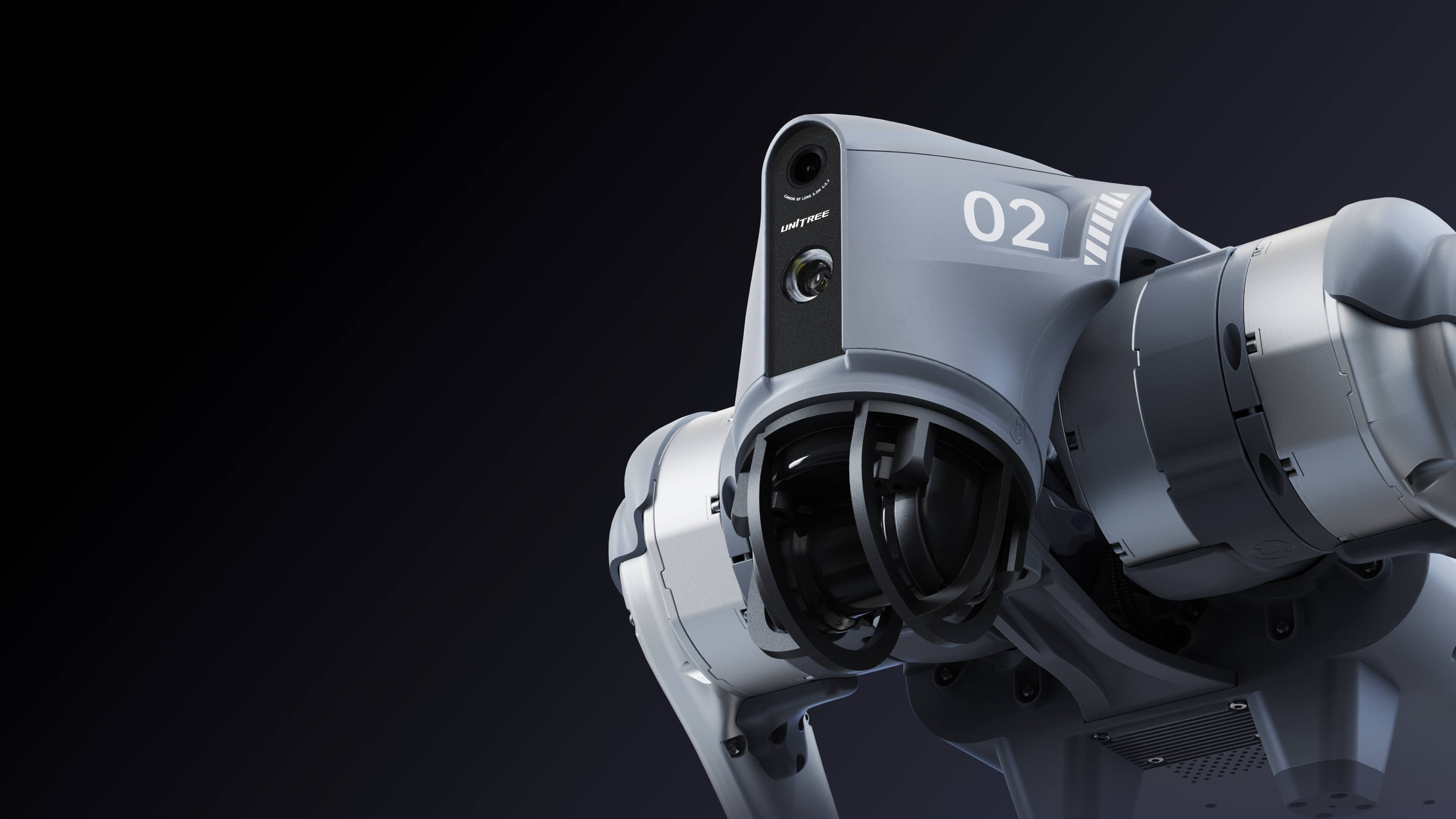
The Go2-W is the right call when your operating environment is predominantly flat — warehouses, offices, exhibition halls, large indoor venues — and speed plus battery life matter more than rough-terrain capability. It is also the easiest quadruped for new operators to handle, since wheeled locomotion is more predictable than fully legged movement.
Side-by-Side: How the Models Compare
| Model | Best For | IP Rating | Top Speed | Indicative Price (USD) |
|---|---|---|---|---|
| Go2 AIR | Research, education, embodied-AI development | — | 5 m/s | ~$1,600 |
| Go2 PRO | Advanced research, higher-end AI workloads | — | 5 m/s | Higher tier |
| Go2 X | Performance development, full SDK exploration | — | 5 m/s | Top consumer tier |
| Go2-W | Indoor / flat-ground use, high efficiency | — | Faster than Go2 | Consumer tier |
| B2 | Industrial inspection, security, outdoor work | IP67 | ~6 m/s | Industrial tier |
| B2-W | Industrial flat-ground work, mixed terrain | IP67 | Faster than B2 | Industrial tier |
| A2 | Heavy-payload industrial integration | Industrial | — | Heavy-duty tier |
Total Cost of Ownership: What People Forget
The indicative USD price is the start of the conversation, not the end. For a realistic South African landed cost, factor in the following.
- Airfreight from China — typically R12,000 to R35,000 depending on model weight and shipping speed
- Customs duty — currently 0% for robotic platforms under most tariff headings, but always verify at quote stage
- 15% VAT — applied to the full landed value including freight
- Spare battery — strongly recommended for any commercial deployment; budget roughly 8-12% of unit price
- Training and integration time — typically 1-3 days for an experienced developer to be productive on the SDK
- Extended warranty — optional, available through MCM Robotics for commercial deployments
As a rough rule, expect total landed South African cost to come in 25-40% above the indicative USD figure once everything is paid for. We provide South African Rand quotes inclusive of all costs on request — there are no hidden line items at delivery.
The Real Cost of Importing Yourself
It is tempting to look at the indicative USD price, find Unitree on AliExpress, and click buy. Do not do this. The maths almost never works out.
First, Unitree warranties are tied to authorised reseller channels. A direct import typically arrives with no valid manufacturer warranty — meaning that if a joint motor fails on day 30, you are paying full retail to ship the robot back to China for repair, or buying replacement parts at distributor markup with no recourse if Unitree declines to honour the claim. On a $1,600 Go2 AIR this is uncomfortable. On a $60,000+ B2, this is catastrophic.
Second, you become the importer of record. That means you are personally responsible for customs clearance, duty calculation, VAT payment, and any compliance documentation South African Revenue Service might request. Get any of this wrong and the robot sits in a SARS warehouse accruing storage fees while you sort it out.
Third, you have no local technical support. The Unitree SDK is well-documented but not trivial. When something does not work — and at some point, something will not work — having a local team that has deployed dozens of these robots before is worth more than any price difference you imagined you were saving.
How to Pick the Right Model for Your Use Case
If you are still uncertain, work through these questions in order.
- Will the robot operate outdoors or in dusty, wet, or temperature-extreme conditions? If yes, you need an IP67-rated model: B2 or B2-W. If no, the Go2 family is the right starting point.
- Will the robot carry heavy payloads, custom sensor packages, or a robotic arm? If yes, look at the A2 for heavy-duty integration. If no, B2 or Go2 are sufficient.
- Is your operating environment predominantly flat? If yes, a wheeled variant (Go2-W or B2-W) will be faster and more battery-efficient. If no, stick with the legged variant.
- What is your primary use case? Research and education point to Go2 AIR. Industrial inspection and security point to B2. Heavy industrial integration points to A2.
- What is your honest budget, all costs in? Add 25-40% to the indicative USD price for landed South African cost. Make sure the budget covers a spare battery and a small training-time buffer.
For a different angle on this decision, our companion piece How to Choose the Right Unitree Robot for Your Business looks at the broader Unitree lineup including humanoids and the R1 dual-arm platform.
What You Get When You Buy Through MCM Robotics
Every Unitree quadruped sold through MCM Robotics ships with the full manufacturer warranty, local technical support, training programmes for operators and integrators, integration assistance for custom deployments, and nationwide delivery across all nine South African provinces. Genuine spare parts are sourced direct from Unitree and held in regional stock. Pricing is transparent and synchronised with Unitree global rates plus the actual landed costs — there is no opaque margin on top of "indicative" figures.
For deeper reading on specific deployment patterns, see our existing posts: Deploying Robot Dogs for Security: A Practical Guide, The Role of LiDAR in Modern Robotics, and Why Africa Is Ready for the Robotics Revolution.
Ready to Choose?
The right next step depends on where you are in the buying process. If you know which model you want, head straight to the product page for indicative pricing and request a South African quote. If you are still narrowing down, get in touch with our team for a guided conversation — we will ask the right questions, work through your operating environment, and recommend the model that actually fits, not the one with the biggest margin.
Browse the full quadruped lineup:
- Unitree Go2 AIR — entry-level, research and education
- Unitree Go2 PRO — mid-tier consumer
- Unitree Go2 X — top-tier consumer
- Unitree Go2-W — wheeled hybrid consumer
- Unitree B2 — industrial flagship
- Unitree B2-W — wheeled industrial
- Unitree A2 — heavy-duty industrial
Frequently Asked Questions
How much does a Unitree quadruped robot cost in South Africa?
Indicative starting prices range from approximately $1,600 USD for the Unitree Go2 AIR (the most accessible model) to over $90,000 USD for the flagship B2 industrial quadruped fully configured. South African landed cost includes airfreight, import duties, and 15% VAT — typically adding 25-40% on top of the indicative USD price. MCM Robotics provides South African Rand quotes inclusive of all costs on request.
Which Unitree quadruped is best for beginners?
The Unitree Go2 AIR is the entry point for most buyers. At roughly $1,600 USD with standard 4D LiDAR L2, an 8-core CPU, and 5 m/s top speed, it delivers serious capability at a hobby-research price point. It is the right choice for educators, students, researchers, and developers who want to learn embodied AI without committing to industrial-grade pricing.
Can I use a Unitree quadruped outdoors in harsh South African conditions?
For sustained outdoor or industrial use, you need an IP67-rated model: the Unitree B2 or B2-W. These are engineered for dust, water exposure, and operating temperatures from -20°C to 55°C — well within South African mining, agricultural, and security deployment conditions. The consumer Go2 line is not rated for sustained outdoor exposure and is best kept to controlled environments.
What is the difference between the Go2 AIR, PRO, and X?
The Go2 AIR is the entry tier with standard 4D LiDAR L2 and an 8-core CPU. The Go2 PRO adds higher-grade computing for advanced AI workloads and improved actuator response. The Go2 X is the performance flagship of the consumer line with extended capabilities for serious development work. All three share the same chassis, battery system, and 5 m/s top speed.
Should I import a quadruped robot myself or buy from a local reseller?
Direct import is almost always a false economy. You forfeit the manufacturer warranty (Unitree warranties are tied to authorised reseller channels), become responsible for customs clearance and 15% VAT, have no local technical support if anything goes wrong, and cannot easily source spare parts. Buying through an authorised reseller like MCM Robotics is typically the same total cost or cheaper once warranty risk is factored in.
How long do Unitree quadruped robots last?
With proper care, expect 3-5 years of active service from a consumer Go2 and 5-7+ years from industrial B2 and A2 platforms. Battery packs are the most consumable component (typical service life is 500-800 charge cycles); they are user-replaceable on every model. Joint motors, gearboxes, and structural components are designed for tens of thousands of hours of continuous operation.
What warranty comes with a Unitree quadruped from MCM Robotics?
Every Unitree quadruped sold through MCM Robotics ships with the full manufacturer warranty — 8 months on the consumer Go2 line and 12 months on the industrial B2, B2-W, and A2 models. Warranty service is handled locally in South Africa, with parts sourced direct from Unitree. Extended warranty options are available on request for commercial deployments.