
What Does IP67 Actually Mean for a Robot?
IP67 is the rating that, more than any other single specification, separates a consumer robot from an industrial one. If you are evaluating a quadruped for outdoor work, security patrol, mining inspection, agricultural fieldwork, or anything else that takes a robot out of a climate-controlled lab, the IP rating is one of the first numbers you should check — and one of the easiest to misread if marketing copy gets in the way.
This guide explains what IP67 actually means, what it does not cover, how it compares to neighbouring ratings, and how to read IP claims without being misled. By the end, you will know exactly what an IP67-rated robot can handle and where it stops.
The Definition in One Sentence
IP67 means a device is completely sealed against dust ingress (the first digit, 6) and can survive being submerged in up to one metre of fresh water for thirty minutes (the second digit, 7). That is the entire definition. Every other claim wrapped around it — "waterproof", "ruggedised", "all-weather" — is marketing language, not standard.
How to Read Any IP Rating
IP stands for "Ingress Protection". The two digits that follow are independent ratings on two scales defined by the international standard IEC 60529.
First Digit: Solid Particle Protection (dust)
- 0 — No protection
- 1 — Protected against objects larger than 50 mm (back of a hand)
- 2 — Protected against objects larger than 12.5 mm (a finger)
- 3 — Protected against objects larger than 2.5 mm (a tool)
- 4 — Protected against objects larger than 1 mm (most wires)
- 5 — Dust-protected (some ingress allowed but not enough to interfere with operation)
- 6 — Dust-tight (no ingress at all)
Second Digit: Liquid Ingress Protection (water)
- 0 — No protection
- 1 — Protected against vertical dripping water
- 2 — Protected against vertical dripping water when tilted up to 15°
- 3 — Protected against water spray up to 60° from vertical
- 4 — Protected against water splashing from any direction
- 5 — Protected against jets of water (6.3 mm nozzle, any direction)
- 6 — Protected against powerful water jets (12.5 mm nozzle)
- 7 — Protected against temporary submersion (up to 1 metre, 30 minutes)
- 8 — Protected against continuous submersion (depth specified by manufacturer)
- 9K — Protected against high-pressure, high-temperature water jets (steam-cleaning grade)
Reading a Rating Quickly
"IP67" reads as: dust-tight + temporary submersion to 1 m for 30 min. "IP65" reads as: dust-tight + jets of water from any direction but no submersion. "IP54" reads as: dust-protected (not dust-tight) + splash-resistant from any angle. The higher the second digit, the more water exposure the device can take.
What IP67 Specifically Allows
For a robot operating in the real world, IP67 means the following are all fine:
- Heavy rain — Operating a robot in a sustained downpour, including driven rain, is well within IP67 tolerance
- Dust storms — Sustained dust exposure (mining sites, agricultural fields, construction sites, the Karoo in a wind) does not penetrate the seal
- Accidental submersion — Stepping into a puddle, falling into a stream, or rolling into a shallow water hazard for under 30 minutes does not damage the robot
- Standard hose-down cleaning — Cleaning the robot with a garden hose between deployments is a normal use case
- Temperature swings within rated range — On the Unitree B2 the rated operating range is -20°C to 55°C, comfortably covering South African conditions year-round
- Mud, grit, and grime — All non-issues for an IP67-sealed enclosure
What IP67 Does NOT Cover
This is where buyers most often get caught out. IP67 is a specific rating with specific limits. The following are all outside the spec:
- Continuous submersion — IP67 covers 30 minutes at 1 metre. For longer or deeper, you need IP68 with the manufacturer's specific depth and duration rating
- High-pressure cleaning — Industrial wash-down with a pressure washer (typically 100+ bar) is outside IP67. For pressure-washable robots you need IP69K
- Steam — IP67 is rated against water, not steam. Steam can penetrate seals that resist liquid water
- Salt water — IP67 testing uses fresh water. Saltwater corrosion is a separate concern; coastal and marine deployments need explicit marine-grade certification
- Chemicals and solvents — Acids, hydrocarbons, cleaning solvents, and industrial process fluids are not covered. If your deployment environment includes these, ask specifically about chemical resistance
- Impact and drop protection — IP ratings cover dust and water only. Shock, vibration, and impact protection are separate ratings (typically a MIL-STD or IK rating)
- Pressure changes — Rapid altitude changes or pressure differentials can stress IP seals; the rating assumes near-atmospheric conditions
IP67 Compared to Neighbouring Ratings
| Rating | Dust | Water | Best For |
|---|---|---|---|
| IP54 | Dust-protected | Splash-resistant | Indoor industrial, occasional outdoor |
| IP65 | Dust-tight | Water jets (no submersion) | Outdoor exposure with no water hazards |
| IP66 | Dust-tight | Powerful water jets | Marine deck, heavy weather, no submersion |
| IP67 | Dust-tight | Submersion 1m / 30min | General outdoor industrial, mining, agriculture, security |
| IP68 | Dust-tight | Continuous submersion (depth varies) | Underwater inspection, swimming-pool robotics |
| IP69K | Dust-tight | High-pressure, high-temperature jets | Food processing, pharmaceutical wash-down environments |
For most outdoor industrial robotics use cases — including the bulk of South African mining, agriculture, security, and infrastructure work — IP67 is the correct rating. IP65 is not enough if there is any chance of submersion or driven rain pooling. IP68 is overkill unless you genuinely need continuous submersion. IP69K is overkill outside food-grade or pharmaceutical-grade wash-down environments.
Why IP67 Matters for Real Robot Deployments
The reason IP67 is the industry shorthand for "industrial-grade" is that it covers the realistic failure modes of an autonomous robot in the field:
A security patrol robot will, at some point, be caught in unexpected rain. An inspection robot in a mine will encounter standing water, condensation, and dust simultaneously. An agricultural robot will operate through irrigation cycles. A robot working a construction site will get hosed down at end of shift.
A consumer-grade robot — even a technically capable one — will fail under any of these conditions. An IP67-rated robot will not. The rating is not just a number on a spec sheet; it is the difference between a robot that works the second time you take it outside and one that needs to be repaired.
The Unitree IP67 Lineup
The Unitree industrial line is sealed for harsh environments:
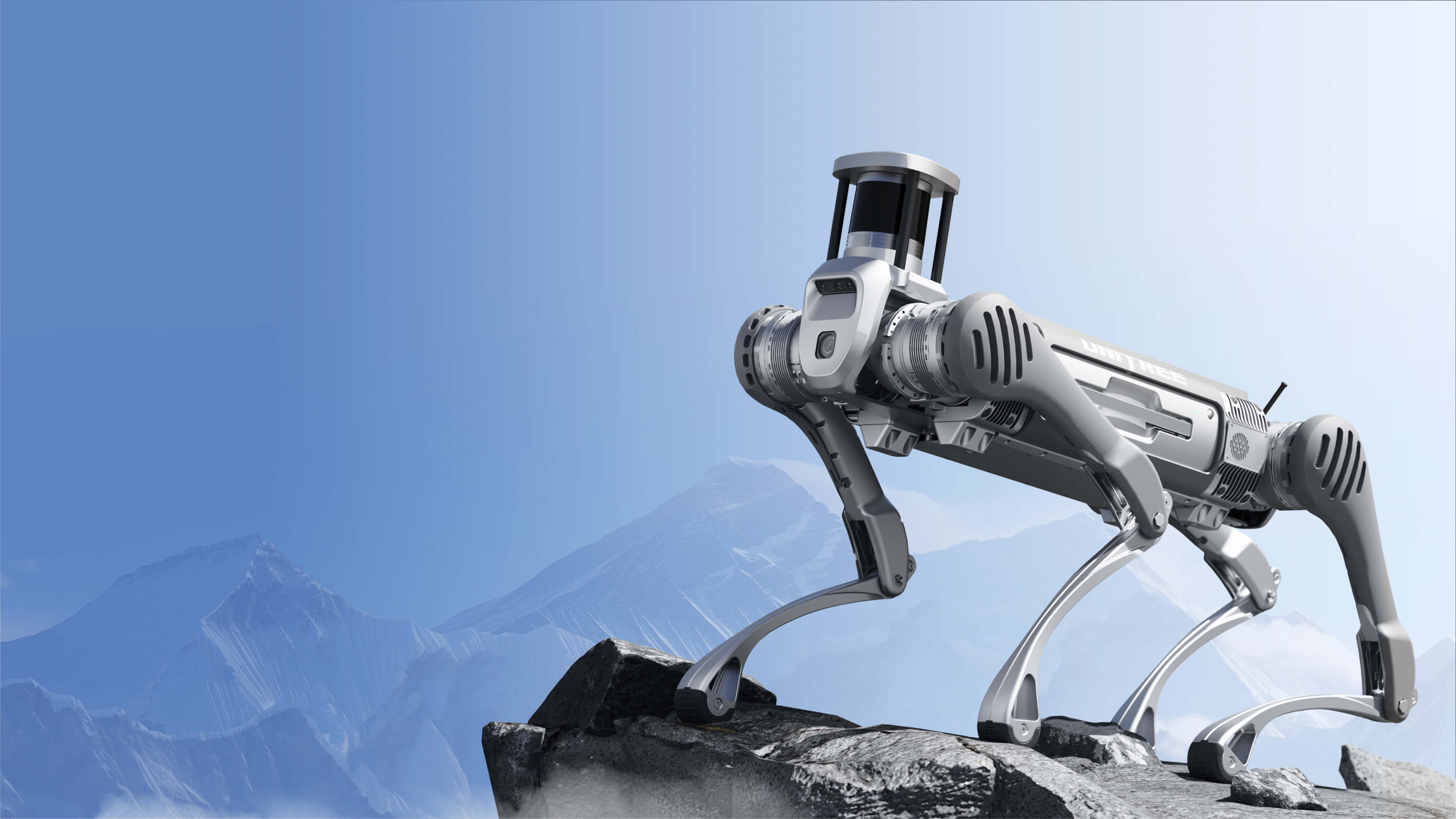
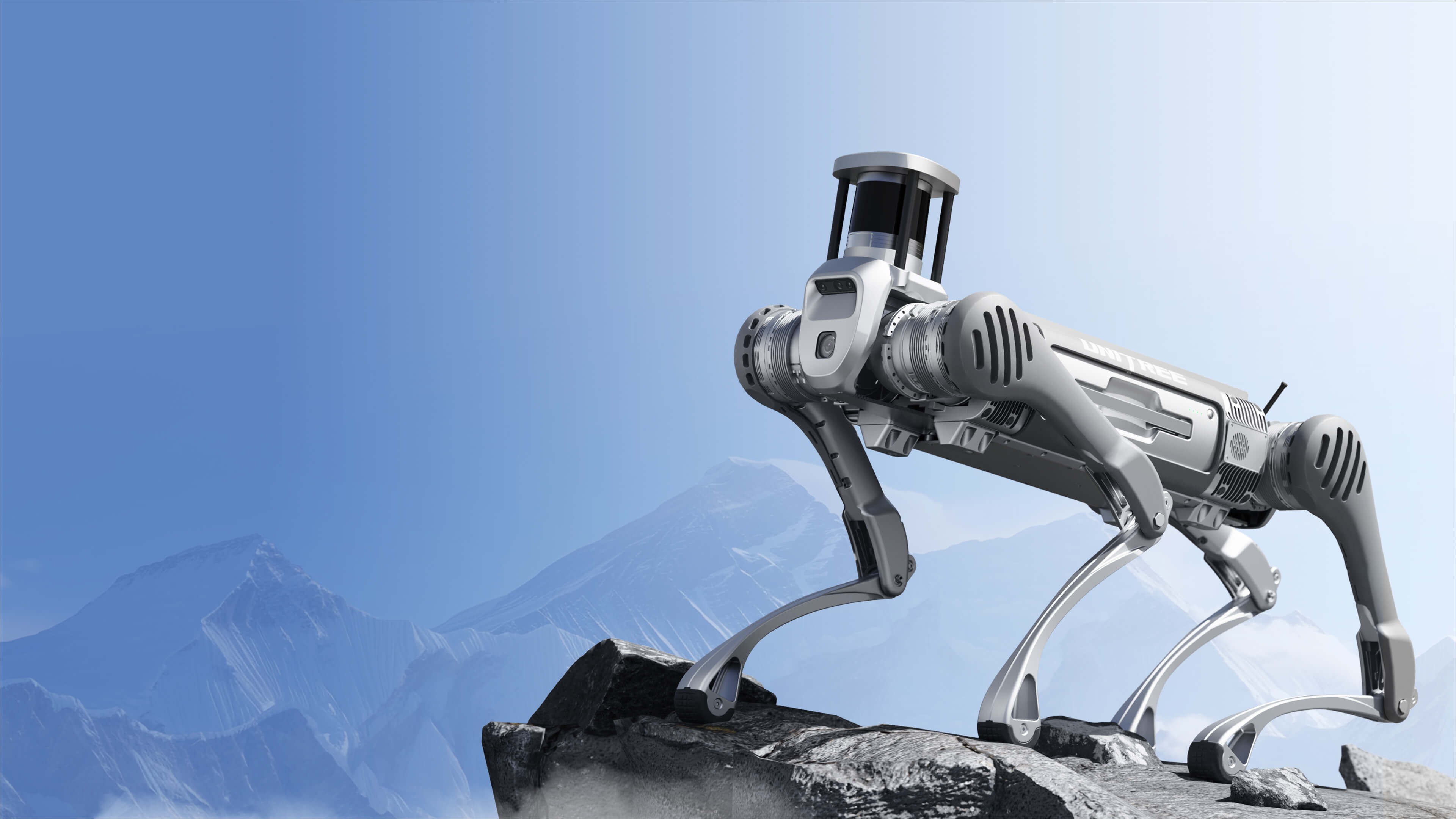
- Unitree B2 — The flagship industrial quadruped. IP67-rated, -20°C to 55°C operating range, engineered for outdoor inspection, security patrol, and rough-terrain work. This is the default recommendation for any sustained outdoor deployment.
- Unitree B2-W — The wheeled-leg hybrid B2 variant. Same IP67 rating, with powered wheels on all four legs for faster, more energy-efficient operation on flat ground. The right choice when most of your environment is paved but you still need true legged capability for stairs and obstacles.
- Unitree A2 — The endurance-focused industrial quadruped, IP56-rated as a whole machine (core components sealed to IP67), lighter than the B2 and built for endurance rather than payload; the B2 carries more. The right choice for industrial integrators mounting sensor packages, robotic arms, or task-specific tooling.
The Unitree Go2 family (AIR, PRO, X, and Go2-W) is not IP67. The Go2 line is designed for controlled environments — labs, classrooms, indoor research, demonstrations, and short outdoor sessions in fair conditions. If you put a Go2 to work in a sustained outdoor industrial role, you are operating it outside its design envelope.
How to Verify an IP Claim
Marketing copy uses words like "rugged", "weatherproof", and "all-terrain" freely. Specifications use IP ratings precisely. When you are evaluating a robot for a deployment with real environmental exposure, do these three things:
- Find the explicit IP rating in the technical specifications — not just in the marketing description. If a vendor cannot point to a specific rating, assume the device is not rated.
- Verify the rating covers your actual deployment conditions — temperature range, water exposure type, dust profile, and any chemical or high-pressure-cleaning needs. Match the rating to the environment, not the other way round.
- Ask about the warranty implications — operating a robot outside its IP-rated conditions will typically void warranty cover. Confirm with your reseller before deploying in an edge-case environment.
For a fuller framework on matching a quadruped to a real deployment, read our Complete Guide to Buying a Quadruped Robot in South Africa. For an honest look at quadrupeds in security work, see Deploying Robot Dogs for Security: A Practical Guide.
The Short Version
IP67 means dust-tight and submersion-resistant to one metre for thirty minutes. It is the rating that makes a robot safe to deploy outdoors, in dust, in rain, and in the kind of real-world conditions that make every other rating insufficient. For South African mining, agriculture, security, and infrastructure work, an IP67-rated quadruped such as the Unitree B2 or B2-W (or the IP56-rated A2 for endurance work) is the right starting point. Anything less is a consumer robot you are misusing.
If you are weighing up which model fits your operating environment, get in touch. We will ask about your actual conditions — temperatures, water exposure, dust profile, deployment duration — and match you to the platform that will still be working in five years, not five weeks.
Frequently Asked Questions
What does IP67 mean in plain English?
IP67 means a device is completely sealed against dust ingress (the 6) and can survive being submerged in up to one metre of fresh water for 30 minutes (the 7). For a robot, this rating is the industry shorthand for "ready for outdoor industrial use" — it can handle rain, dust storms, accidental submersion in puddles, and standard hose-down cleaning without damage.
Is IP67 better than IP65?
For most outdoor and industrial robot use cases, yes. IP65 protects against jets of water (a hose held at 6.3 mm nozzle, from any direction) but does not allow submersion. IP67 adds the submersion protection, which matters in real-world deployment: robots fall into puddles, get hit by sudden flooding, or accidentally roll into streams. IP67 covers those scenarios; IP65 does not.
Is IP67 the same as waterproof?
No. "Waterproof" is a marketing word with no formal definition. IP67 is a precise standard with measurable test conditions: 1 metre depth, fresh water, 30 minutes, static immersion. It is not rated for continuous submersion, pressurised water (high-pressure cleaning equipment), salt water, steam, or chemical exposure. For continuous submersion you need IP68; for high-pressure cleaning you need IP69K.
Which Unitree robots are IP67-rated?
The IP67-rated models are the Unitree B2 quadruped and the B2-W wheeled-leg hybrid. The A2 endurance quadruped is IP56-rated as a whole machine, with core components sealed to IP67. The consumer Go2 family (AIR, PRO, X, and Go2-W) is not IP67 — those models are built for controlled environments and are not rated for sustained outdoor exposure. If your operating environment is dusty, wet, or temperature-extreme, you need a B2 or A2, not a Go2.
Can an IP67 robot be used in South African mining sites?
Yes — IP67 covers the dust and moisture conditions of most South African mining, agricultural, and security deployment environments. The Unitree B2 quadruped is specifically engineered for this profile, with an operating temperature range from -20°C to 55°C that covers everything from Free State winter mornings to peak Karoo summer heat. For high-pressure wash-down environments (food processing, certain mining processes) you may need to add wash-down covers or move up to IP69K-rated equipment.
How is IP67 actually tested?
Under IEC 60529, the dust test (the 6) places the device in a sealed chamber with talcum powder for 8 hours under vacuum to confirm no powder ingress at all. The water test (the 7) submerges the device in fresh water at a depth measured to the bottom of the device, with the top no less than 0.15 metres below the surface, for 30 minutes. The device is then powered up and inspected internally for any moisture that compromises function.