
Unitree Go2 ISS 2.0: The Intelligent Side-Follow System Explained
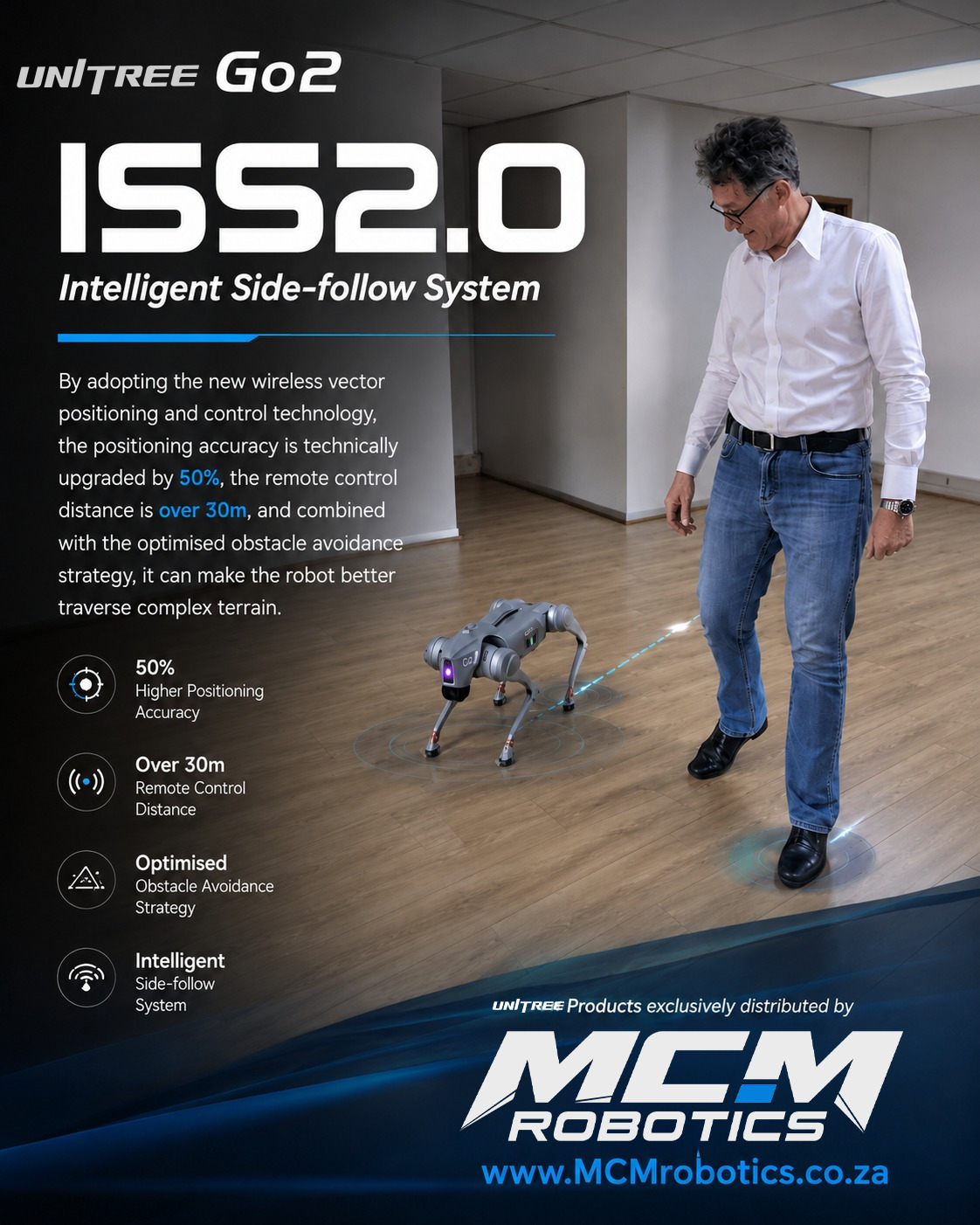
ISS 2.0, the Intelligent Side-follow System, is the Unitree Go2's ability to travel alongside its handler rather than trail behind them, and the 2.0 revision is what finally makes it dependable outside a demo room. Unitree has rebuilt the feature around new wireless vector positioning and control technology, quoting a 50% improvement in positioning accuracy, a remote control distance of over 30 metres, and an optimised obstacle avoidance strategy that helps the robot hold station beside you across complex terrain.
That combination matters more in South African conditions than the spec sheet suggests. A robot that walks a metre off your hip through a substation yard, a packhouse aisle or a mine access road is doing something quite different from one that plods along behind you. It stays in your peripheral vision, its sensors face the same direction you are looking, and you are not constantly turning around to check on a fifteen-kilogram machine. This guide unpacks what side-follow actually is, what changed in version 2.0, which Go2 models include it, and where it earns its keep on local sites.
What Is the Intelligent Side-Follow System?
Side-follow is a handler-relative motion mode. Instead of driving the robot with a joystick, or sending it to a waypoint and hoping, you tell the Go2 to hold a position relative to you, and then you simply walk. The robot maintains that offset, matching your pace, adjusting its gait for the ground underneath it, and routing around obstacles that you stroll past without thinking.
The technical problem this solves is deceptively hard. To hold a position beside a moving person, the robot needs to know continuously where that person is: not roughly, but precisely enough to distinguish "half a metre left of my hip" from "directly in front of my next footfall". It needs to update that estimate many times a second, and it needs to keep working when the handler changes direction abruptly, walks behind a pillar, or steps onto a surface where the robot's footing changes. This is where the "vector" in wireless vector positioning matters, because the system resolves both the direction and the distance between handler and robot, rather than just a proximity reading.
Side-Follow Is Not the Same as Follow-Me
Plenty of machines claim a follow-me mode. Most of them implement it as a tail: the robot locks onto a target and drives towards where the target just was. It works, but it produces the familiar drunken-puppy effect. The robot cuts corners, overshoots when you stop, and disappears from view exactly when you want to see it.
Side-follow inverts the geometry. The robot is not chasing a point; it is maintaining an offset in a moving frame of reference. The practical differences are immediate:
- You can see it. A robot at your side stays in your peripheral vision. You notice a stumble, a snagged foot or an obstacle before it becomes an incident.
- Its sensors face your way. A Go2 walking beside you is looking roughly where you are looking. For inspection and patrol work, that is the whole point, because its camera and LiDAR cover the same scene you are assessing.
- It stops being a trip hazard. A machine behind your heels is a machine you will eventually walk into. Beside you, it is a companion, not an obstacle.
- Hands stay free. You are walking, not driving. You can carry a tablet, a torch or a toolbag and let the robot keep up.
What Changed in ISS 2.0
Version 2.0 is not a cosmetic revision. Unitree rebuilt the positioning layer, and the three headline numbers all trace back to that single change.
50% Higher Positioning Accuracy
Unitree quotes the positioning accuracy as technically upgraded by 50% over the previous generation. Accuracy is the quiet foundation of everything else in side-follow. If the robot's estimate of where you are drifts, it must build in a safety margin, and that margin shows up as sloppy behaviour. It hangs back further than it needs to. It hesitates when you change direction. It stops for obstacles that were never in its path.
Halve the error and the robot can afford to be decisive. It holds a tighter, more consistent offset, tracks direction changes without lag, and stops treating your own legs as an obstacle to be negotiated. In a warehouse aisle or between the rails of a packhouse line, the difference between a metre of positional uncertainty and half a metre is the difference between a feature you use and a feature you switch off.
Over 30 Metres of Remote Control Distance
The quoted control range is now over 30 metres. That figure is easy to skim past, but it changes the shape of the jobs you can do. Thirty metres is the far side of a substation yard. It is the length of a packing shed. It is far enough to send the robot ahead into a space you would rather assess on a screen before you walk into it yourself: a confined area, an unlit store room, the downwind side of a spill.
Range and accuracy also compound. A long-range link that degrades into vagueness at distance is not usable for side-follow, because the robot's behaviour gets worse precisely when you can least afford to babysit it. Improving both together is what makes the number meaningful rather than a headline.
Optimised Obstacle Avoidance
The third change is a reworked obstacle avoidance strategy, and Unitree ties it directly to traversing complex terrain. This is the part that matters most on South African sites, because "complex terrain" here is not a laboratory obstacle course. It is a gravel yard with a drainage channel across it. It is the lip where a concrete apron meets dirt. It is a cable tray, a pallet corner, a hose run.
The strategic distinction is between avoiding an obstacle and avoiding it while holding formation. A naive system treats every obstacle as a reason to stop or to break off. An optimised one understands that the robot has a job, which is to stay beside the handler, and plans a deviation that satisfies both goals: clear the obstacle, then recover the offset. That is why obstacle avoidance and side-follow were upgraded together rather than separately.
How Wireless Vector Positioning Works
Unitree describes the underlying change as new wireless vector positioning and control technology. The word doing the work is "vector".
A scalar positioning system tells you how far away something is. That alone is close to useless for side-follow, because knowing the handler is two metres away describes a circle, not a place. A vector system resolves distance and bearing, which collapses that circle to a point. Once the robot knows both, it can compute the offset it is supposed to hold and drive its legs to maintain it.
This is also why the feature is robust in ways a camera-only approach is not. Vision-based following depends on seeing the target: it degrades in dust, in low light, in glare, and it fails outright when someone in a similar jacket walks between you and the robot. A wireless positioning link does not care what you are wearing, whether the sun is behind you, or whether a colleague crosses the gap. For a machine that has to work in a packhouse at dawn or a yard at dusk, that difference is decisive.
The Go2's other sensing does not go away. Its LiDAR and camera continue to handle the environment, covering the ground, the obstacles and the gaps, while the wireless link handles the one thing they are worst at: knowing, reliably and continuously, exactly where the handler is. The two layers do different jobs, and ISS 2.0 improves the one that was holding the system back.
Which Go2 Models Include ISS 2.0
Side-follow is included from the Go2 Pro upwards. The entry-level Go2 Air is the one model in the range that does not carry it. The Air is built as an accessible introduction to the platform, and side-follow is part of what you step up for.
| Model | ISS 2.0 side-follow | Price (ZAR, ex VAT) |
|---|---|---|
| Go2 Air | Not included | R32,375 |
| Go2 Pro | Included | R53,375 |
| Go2-X | Included | R78,750 |
| Go2 EDU-U1 | Included | R105,000 |
| Go2 EDU-U2 | Included | R148,750 |
| Go2 EDU-U3 | Included | R201,250 |
| Go2 EDU-U4 | Included | R227,500 |
For most buyers whose interest is side-follow specifically, the Go2 Pro is the model to look at. It is the cheapest configuration that includes ISS 2.0, and it pairs it with voice control, the 4G eSIM and the mobile app. Stepping up to the Go2-X or the EDU line buys you development capability (secondary development access, foot sensors, Isaac Sim support) rather than a better version of side-follow. If you want a robot that walks beside you and you do not intend to write code for it, the Pro is the sweet spot.
Prices above are ex VAT, in line with how we quote across the range. Freight, import and customs clearance, local delivery and VAT are itemised separately on your quotation, so you see exactly what lands the machine in South Africa rather than a bundled number.
Where Side-Follow Earns Its Keep in South Africa
Security and Estate Patrols
A guard walking a perimeter with a Go2 at their side is a different proposition from a guard walking alone. The robot's camera covers ground the guard's back is turned to; its presence is a visible deterrent; and its footage is a record. Because the handler is not driving it, their attention stays on the environment, which is the entire reason they are there. Our guide to deploying robot dogs for security covers the operational side in more depth.
Industrial Inspection
Inspection rounds are repetitive, and repetition is where attention fails. A Go2 holding station beside an inspector captures a consistent visual record of every round, from roughly the same vantage point, without anyone remembering to do it. The 30-metre control range matters here too, because there are spaces on a plant where the sensible order of operations is to send the robot in first and read the screen before you commit.
Agriculture and Land Survey
Row crops, orchards and packhouses are exactly the "complex terrain" the obstacle avoidance upgrade targets: uneven ground, irrigation lines, tight turns, and surfaces that change from concrete to soil in a single stride. A machine that keeps formation across that transition, rather than stopping to think about it, is the difference between a tool and a demonstration.
Film, Events and Marketing
Side-follow is a gift to anyone who needs a camera to travel alongside a subject at walking pace. It is also, frankly, the most effective product demonstration in the Unitree range. A robot that walks beside a person, holding its offset while the person moves naturally, communicates the platform's capability faster than any spec sheet.
Research and Education
For universities and technical colleges, ISS 2.0 is a working example of sensor fusion and control theory that students can walk alongside. The EDU models add secondary development access on top, letting students build against the platform rather than only observe it.
Getting the Best Out of ISS 2.0
A few practical points, learned the way these things usually are:
- Walk at a human pace. The Go2 tops out around 2.5 m/s, which is faster than you walk, but side-follow is not a race. Consistent pace produces consistent behaviour.
- Give it a lane. The robot needs somewhere to be. Hugging a wall on the robot's side leaves it nowhere to hold its offset, and it will fall back.
- Mind the battery. The Go2's 8,000 mAh pack gives roughly one to two hours of operation. A patrol route should be planned around that, not discovered by it.
- Respect the climb limits. The Go2 handles steps up to about 15 cm and slopes to around 30 degrees. Side-follow does not change the physics: if you step up a loading dock, the robot is not coming with you.
- Keep the feet and joints clean. Dust and grit are the enemy of any legged machine in local conditions. Our quadruped maintenance guide covers this properly.
What ISS 2.0 Does Not Do
It is worth being clear about the boundaries, because the gap between what a feature does and what a buyer imagines it does is where disappointment lives.
ISS 2.0 is not autonomous navigation. The robot is not deciding where to go; you are, by walking. It will not patrol a route on its own because you showed it once, and it will not find its own way back. It is a handler-relative mode, and the handler is doing the navigating.
It is also not a substitute for the Go2's physical limits. Side-follow does not extend the battery, raise the payload beyond roughly 7 kg standard, or let the robot climb something it could not otherwise climb. And it is bounded by range: past the quoted 30-plus metres you are outside the envelope the feature is specified for.
Finally, it does not make the robot invisible to its surroundings. In a genuinely crowded space, such as a busy shop floor at shift change, a fifteen-kilogram machine holding station beside you is still a fifteen-kilogram machine that people will walk into. Side-follow is at its best where there is room to use it.
What a Go2 Costs in South Africa
The Go2 Pro, the entry point for ISS 2.0, starts at R53,375 ex VAT. Against that, the Air at R32,375 looks tempting until you notice that side-follow is one of the things the extra buys, alongside voice control and the 4G eSIM.
Every quote we issue itemises the full landed picture: the machine, international air freight, import and customs clearance, local delivery anywhere in South Africa, and VAT. Nothing is bundled and nothing is hidden, which means you can see precisely what each component costs rather than working backwards from a single figure. If you are weighing the Go2 against the heavier B2 platform, that comparison is worth reading first, because the two machines are aimed at genuinely different jobs.
Frequently Asked Questions
What is the Intelligent Side-follow System (ISS 2.0)?
ISS 2.0 is the Unitree Go2's handler-relative motion mode. It uses wireless vector positioning to resolve both the distance and direction between the handler and the robot, allowing the Go2 to walk alongside its handler at a consistent offset rather than trailing behind. Version 2.0 adds 50% higher positioning accuracy, over 30 metres of control range and an optimised obstacle avoidance strategy.
Which Unitree Go2 models include ISS 2.0?
ISS 2.0 is included on the Go2 Pro and every model above it: the Go2-X and the full EDU range (U1 through U4). The entry-level Go2 Air does not include side-follow. The Go2 Pro, at R53,375 ex VAT, is the most affordable model with the feature.
How far away can the Go2 be controlled?
Unitree quotes a remote control distance of over 30 metres for ISS 2.0, up from the previous generation. Real-world range depends on the environment, since open ground behaves differently from a structure full of steel and concrete.
How much more accurate is ISS 2.0 than the previous version?
Unitree states that positioning accuracy is technically upgraded by 50%. In practice that shows up as tighter, more decisive formation-keeping, with less hesitation when you change direction and a more consistent offset.
Can the Go2 side-follow over rough or uneven ground?
Yes. The optimised obstacle avoidance strategy in ISS 2.0 is specifically aimed at helping the robot traverse complex terrain while holding formation. The Go2's underlying limits still apply: steps up to roughly 15 cm and slopes to around 30 degrees.
Do I need the Go2's LiDAR for side-follow to work?
Side-follow positioning is handled by the wireless link rather than by vision, which is why it holds up in dust, glare and low light where a camera-based follow mode struggles. The Go2's LiDAR and camera continue to handle the environment (ground, obstacles and gaps), so the two systems work together rather than replacing one another.
Talk to Us About the Go2
MCM Robotics is the official Unitree distributor for South Africa. We hold stock, quote in Rand, itemise the full landed cost, and support the machines locally from George in the Western Cape. If you want to see ISS 2.0 walking beside you rather than read about it, get in touch, or browse the Go2 range and its configurations.