
Collaborative Robot Arms for SA Factories
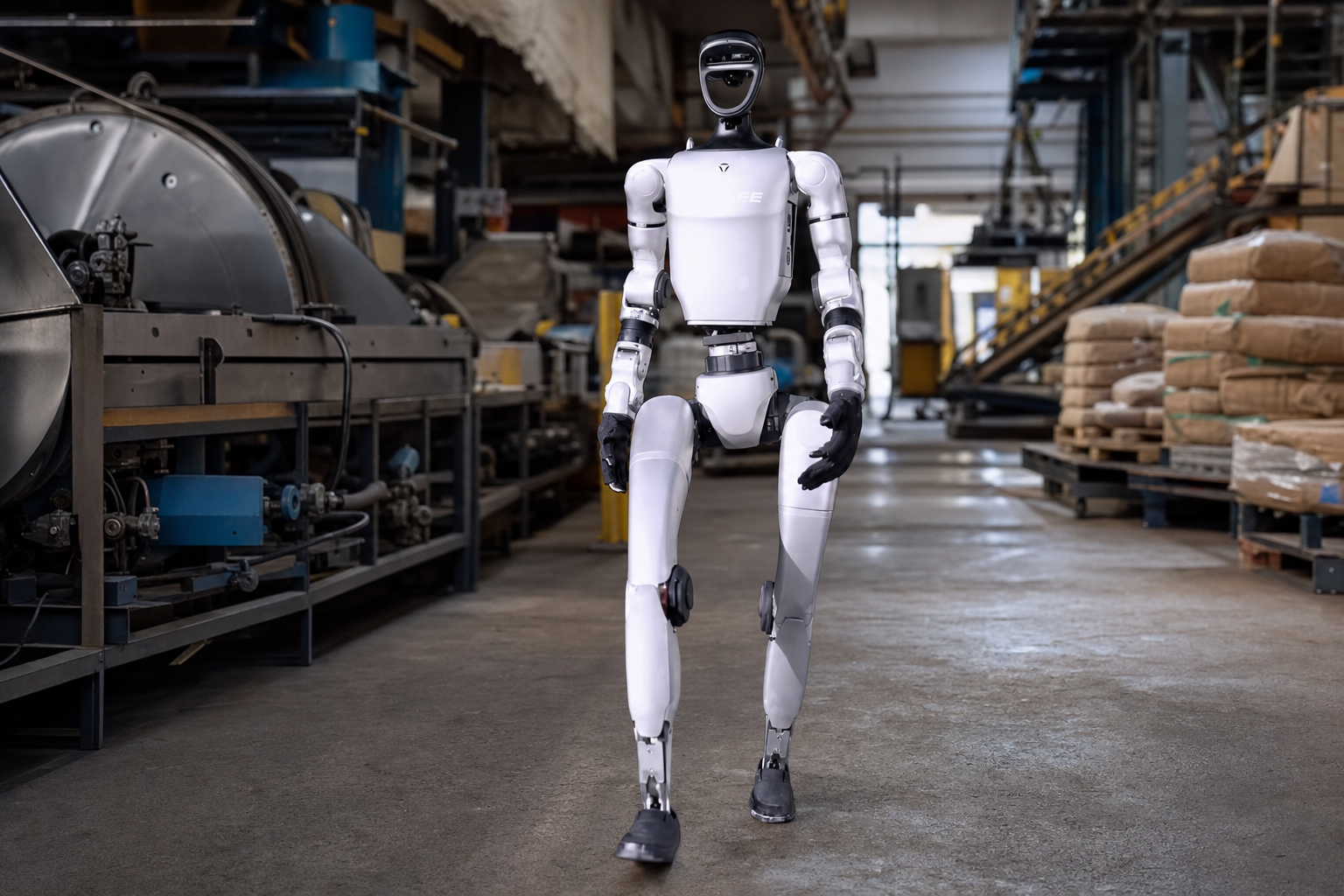
A collaborative robot arm — or cobot — is a lightweight, sensor-rich manipulator designed to work alongside human operators rather than replace them, and South African factories and farms are increasingly adopting them to close the productivity gap. Unlike traditional industrial robots locked behind safety cages, cobots use force-torque sensing, vision systems, and embodied AI to detect human presence and slow or stop automatically, making them safe enough to deploy on open production floors, packhouses, and even in the field.
South Africa's manufacturing and agricultural sectors face a unique set of pressures: load-shedding-driven automation demands, rising labour costs, skills shortages, and the need to compete globally while supporting local employment. Cobots sit at the intersection of all these challenges — they extend the capability of existing workers, operate reliably on backup power, and can be redeployed across tasks without specialist programming teams. This guide unpacks how collaborative robot arms work, what they cost, where they add the most value in SA contexts, and what you need to know before making the investment.
What Is a Collaborative Robot Arm?
A cobot is a robotic manipulator — typically with four to seven axes of movement — built to ISO/TS 15066 safety standards that allow it to share a workspace with people. The defining features that separate a cobot from a conventional industrial robot are force-limiting joints, rounded exteriors with no pinch points, and integrated sensors that continuously monitor contact forces. When the robot detects unexpected resistance — a human hand, a misplaced tool, an animal — it stops within milliseconds.
Leading cobot platforms used in Southern African deployments include Universal Robots (UR3e through UR20), FANUC CRX, Doosan Robotics, and the rapidly growing Elephant Robotics ecosystem. Unitree's Z1 and D1 arms are research and education manipulators rather than certified cobots. Payload capacities range from 3 kg for delicate assembly or laboratory tasks up to 35 kg for palletising and heavy agricultural handling. Reach spans from roughly 500 mm for benchtop work to over 1 700 mm for wide-area coverage on a packing line.
How Cobots Differ from Traditional Industrial Robots
| Feature | Traditional Industrial Robot | Collaborative Robot Arm |
|---|---|---|
| Safety enclosure | Mandatory cage or light curtain | Not required in most deployments |
| Programming | Specialist robotics engineer | Hand-guided teach-in or tablet UI |
| Redeployment time | Days to weeks | Hours to one shift |
| Typical payload | 5 kg – 2 000 kg | 3 kg – 35 kg |
| Floor space | Large, fixed cell | Small footprint, often mobile-mounted |
| Capital cost (ZAR) | R800 000 – R5 000 000+ | R180 000 – R750 000 |
| Suitable for SMEs | Rarely | Yes |
Key Applications in South African Industry
The versatility of a collaborative robot arm means it rarely stays on one task for its entire service life. SA manufacturers and agri-processors are deploying cobots across a surprisingly wide range of operations.
Manufacturing and Assembly
Automotive component suppliers in the Gauteng and Eastern Cape corridors use cobots for torque-critical fastening, quality inspection, and machine tending — loading CNC lathes or injection moulding machines so human operators can focus on set-up and quality checks. The cobot works at a consistent pace regardless of shift fatigue, reducing rework rates and improving first-pass yield. For context on how robotics is already transforming adjacent heavy industries, see our 2026 status report on robotics in South African mining.
Agricultural Processing and Packhouses
South Africa's deciduous fruit, citrus, and vegetable export sectors are under intense pressure to meet EU phytosanitary and traceability requirements. Cobots fitted with vision-guided end effectors can grade, orient, and pack produce at speeds human packers cannot sustain over a full shift, while simultaneously logging weight, colour, and defect data to a cloud ERP. Seasonal labour shortages in the Western Cape and Limpopo make cobot-assisted packing lines especially attractive — the robot handles repetitive high-volume picking while human workers manage exceptions, bin changes, and quality sign-off.
Beyond packhouses, cobots mounted on mobile platforms are beginning to appear in greenhouse operations for seedling transplanting, pesticide application, and harvesting of high-value crops such as tomatoes and strawberries. The combination of a cobot arm with the kind of spatial awareness provided by 4D LiDAR sensing allows the system to navigate row crops and detect ripe fruit with a level of precision that older machine-vision setups could not achieve.
Food and Beverage Processing
Hygienic-design cobot variants — with stainless-steel bodies and IP67-rated joints — are deployed in meat processing, dairy filling lines, and beverage palletising. Understanding what IP67 actually means for a robot is critical when specifying a cobot for a wet or washdown environment; not all cobots on the market meet this standard out of the box.
Logistics and Warehousing
E-commerce growth in South Africa has pushed 3PL operators to explore cobot-based goods-to-person picking and parcel induction. A cobot arm integrated with a conveyor system can induct 600–900 parcels per hour with near-zero mis-sort rates, operating through loadshedding on a UPS or generator without the restart delays that plague human-operated lines.
Cobot Safety: What SA Employers Must Know
Safety compliance for cobots in South Africa is governed by the Occupational Health and Safety Act (Act 85 of 1993) and its Driven Machinery Regulations, read alongside the international standard ISO/TS 15066:2016 for collaborative robot systems. Before any cobot is commissioned, a formal risk assessment must be conducted to determine the maximum permissible contact forces for each body region a worker might contact, the required stopping time, and whether additional safeguards — such as speed-and-separation monitoring via a safety-rated camera — are needed.
- Force and power limiting — the cobot's joints must be configured to stop at contact forces below the ISO/TS 15066 biomechanical limits for the relevant body part.
- Speed and separation monitoring — when a worker enters the cobot's monitored zone, the system reduces speed proportionally and comes to a protective stop before contact; contact-tolerant operation is the separate power-and-force-limiting mode.
- Safety-rated end effectors — a sharp gripper or vacuum cup with a hard edge can cause injury even if the arm stops correctly; end effector design is part of the risk assessment.
- Operator training — the OHS Act requires that all operators and maintenance personnel receive documented training before working with or near the cobot.
- Regular re-assessment — any change to the task, payload, or workspace layout triggers a new risk assessment under ISO/TS 15066.
The ISO/TS 15066 standard is available from the South African Bureau of Standards (SABS) and should be part of every cobot procurement conversation with your supplier.
Cobots in Agriculture: Efficiency and Sustainability
The agricultural angle is where cobots arguably offer their most transformative value for South Africa. With water scarcity, soil degradation, and export-market compliance costs all intensifying, precision automation is no longer a luxury — it is a competitive necessity.
Reducing Input Waste
A cobot-guided spraying or fertigation arm can apply inputs at the individual plant level, cutting chemical use by 30–60% compared with broadcast application. This directly reduces runoff into the Breede, Berg, and Limpopo river systems — a sustainability outcome that is increasingly demanded by EU buyers under the Farm to Fork strategy.
Extending the Harvest Window
Labour availability peaks and troughs are the single biggest constraint on SA fruit and vegetable harvest efficiency. A cobot picking or grading line that operates across two shifts with one supervisor per shift effectively doubles throughput capacity without doubling the headcount, allowing producers to clear a block before a weather event or to meet an urgent export booking.
Data Collection and Traceability
Every cobot cycle generates timestamped data — weight, vision inspection result, operator ID, batch number. This data feeds directly into GLOBALG.A.P. and Tesco Nurture traceability systems, reducing the manual record-keeping burden on farm managers and making audit preparation a matter of exporting a report rather than reconstructing paper records.
Compatibility with Existing Machinery
One of the most common concerns from SA agri-processors is whether a cobot can be bolted onto an existing packing line or grader without a full-line replacement. The answer is almost always yes, provided the integration is planned carefully. Cobots communicate via standard industrial protocols — Modbus TCP, EtherNet/IP, PROFINET — meaning they can read and write to most PLCs already on site. A system integrator will map the cobot's I/O to the existing conveyor controls, define the handshake signals, and commission the vision system against the specific fruit variety or pack format in question. The typical integration project for a single cobot station on an existing line runs four to eight weeks from order to sign-off.
Cost-Effectiveness for South African SMEs
A well-specified cobot installation in South Africa typically achieves payback in 18 to 36 months for an SME running a single shift, and in 10 to 18 months for a double-shift operation. The calculation hinges on four variables: the labour cost being displaced or redeployed, the throughput uplift, the quality improvement (rework and waste reduction), and the financing structure.

ZAR-denominated lease and rental options are now available from several SA robotics distributors, reducing the upfront capital barrier to entry. A cobot on a 36-month operating lease can be cash-flow positive from month one if it displaces more than approximately 1.8 full-time equivalent positions at minimum wage — a threshold most packhouse and assembly applications clear comfortably. Import duties and VAT on cobot hardware should be factored into the total cost of ownership; at the time of writing, most cobot arms attract a 0% import duty under SARS tariff heading 8479.50, though VAT at 15% applies.
For SMEs evaluating their first automation investment, it is worth noting that cobots are not the only robotic platform gaining traction in SA industry. Quadruped robots for inspection and logistics are also on the rise — the complete guide to buying a quadruped robot in South Africa offers a useful parallel framework for thinking through total cost of ownership, deployment readiness, and local support.
Workforce Impact: Productivity and Job Satisfaction
The fear that cobots will eliminate jobs is understandable but, in the South African context, largely misplaced. Most SA cobot deployments are driven not by a desire to reduce headcount but by an inability to find sufficient skilled labour, or by the need to protect workers from ergonomically damaging repetitive tasks. The evidence from global deployments — and from early SA case studies in the Western Cape fruit industry — consistently shows that cobots shift workers from physically demanding, low-skill repetitive tasks to higher-value roles such as quality control, machine supervision, and data management.
Workers who transition from manual packing to cobot supervision typically report higher job satisfaction, lower physical injury rates, and greater pride in their output quality. Employers report lower absenteeism and reduced turnover in cobot-assisted lines. The International Federation of Robotics notes in its annual World Robotics report that countries with higher robot density consistently show lower manufacturing unemployment — a counterintuitive but well-documented phenomenon driven by the competitiveness gains that keep factories viable.
Training is the critical enabler. A cobot that is handed to an unprepared workforce will underperform. The most successful SA deployments pair the hardware installation with a structured upskilling programme — typically 16 to 40 hours of hands-on training — that gives operators the confidence to hand-guide the robot, modify waypoints, and troubleshoot common faults without calling a technician.
Customisation: Adapting Cobots to Your Specific Task
One of the cobot's greatest strengths is its adaptability. The arm itself is a general-purpose platform; the end effector — the tool at the tip of the arm — defines what the robot actually does. SA system integrators offer a wide library of end effectors and can design bespoke tooling for unusual applications.
- Vacuum grippers — ideal for smooth-surfaced produce, cartons, glass, and sheet metal; available in single-cup and multi-cup configurations.
- Parallel jaw grippers — for cylindrical or irregular objects; force-controlled variants are safe for fragile items like eggs or soft fruit.
- Tool changers — allow a single cobot to swap between a welding torch, a screwdriver, and an inspection camera within a single programme, maximising utilisation.
- Soft robotic grippers — silicone or fabric actuators that conform to irregular shapes; increasingly popular for handling leafy vegetables, stone fruit, and baked goods.
- Vision systems — 2D or 3D cameras mounted on the arm or overhead; enable bin-picking, defect detection, and label verification without fixed part presentation.
Software customisation is equally important. Most cobot platforms support ROS 2 (Robot Operating System) integration, allowing developers to build bespoke applications in Python or C++ and connect to cloud analytics, MES systems, or — increasingly — large language model interfaces that allow operators to instruct the robot in plain language. This trajectory mirrors the broader shift towards embodied AI platforms that can reason about their environment rather than simply execute pre-programmed waypoints.
Choosing the Right Cobot for Your SA Operation
Before approaching a supplier, define your application requirements precisely: payload (including end effector mass), reach, cycle time, required I/O, environmental rating, and whether the cobot needs to be mobile or fixed. Then evaluate suppliers on four criteria beyond hardware spec: local support capability (response time, spare parts in-country), application engineering experience in your industry, training offering, and total cost of ownership over a five-year horizon including maintenance contracts.
South Africa has a small but growing ecosystem of certified cobot integrators, concentrated in Gauteng, the Western Cape, and KwaZulu-Natal. The Universal Robots partner network is a useful starting point for finding accredited integrators, though other cobot brands have their own partner directories. Always ask for local reference sites you can visit before committing to a platform.
If your operation involves outdoor or semi-structured environments — greenhouses, open packsheds, or mobile agricultural platforms — also consider how the cobot will be protected from dust, moisture, and UV. This is where IP ratings and ruggedisation specifications become critical selection criteria, as explored in our post on what IP67 means for a robot in practice.
Getting Started with Cobots in South Africa
The most effective way to begin a cobot journey is with a focused pilot project on a single, well-defined task — not a full-line transformation. Choose a process that is repetitive, ergonomically problematic, or chronically understaffed. Define a clear success metric (throughput, defect rate, injury frequency). Run the pilot for 60 to 90 days, gather data, and use it to build the business case for expansion.
MCM Robotics works with SA manufacturers, agri-processors, and logistics operators to specify, integrate, and support collaborative robot arm deployments that are right-sized for the local context. Whether you are exploring your first cobot or scaling an existing automation programme, contact our team for a no-obligation consultation and site assessment — we will help you identify the highest-value application in your operation and model the return on investment in ZAR terms before you commit to any hardware.
Frequently Asked Questions
What are the benefits of using collaborative robots in agriculture?
Cobots in agriculture reduce physical strain on workers, extend the effective harvest window by enabling multi-shift operation with minimal additional headcount, cut input waste through precision application, and generate the traceability data required by export markets. They are particularly valuable in SA's fruit, vegetable, and greenhouse sectors where seasonal labour shortages and export compliance costs are acute.
How do cobots integrate with existing agricultural machinery?
Most cobots communicate via standard industrial protocols such as Modbus TCP, EtherNet/IP, and PROFINET, allowing them to interface with existing PLCs, conveyors, graders, and sorting lines without replacing the underlying machinery. A system integrator maps the cobot's I/O to existing control systems and commissions the vision or sensing layer against the specific crop or pack format. Typical integration time for a single station on an existing packhouse line is four to eight weeks.
What safety measures are necessary when implementing cobots in industrial settings?
SA employers must conduct a risk assessment per ISO/TS 15066:2016 and comply with the OHS Act (Act 85 of 1993) Driven Machinery Regulations. Key measures include configuring force-limiting joints below biomechanical thresholds, implementing speed-and-separation monitoring, selecting safe end effectors with no sharp or pinch-point surfaces, providing documented operator training, and re-assessing risk whenever the task or workspace changes.
Can cobots be customised for specific tasks in different industries?
Yes. The cobot arm is a general-purpose platform; customisation happens primarily through the end effector (vacuum gripper, parallel jaw, soft robotic gripper, welding torch, inspection camera) and the application software. Tool-changer systems allow a single arm to perform multiple tasks within one shift. Software customisation via ROS 2 or the cobot's native SDK enables integration with MES, ERP, and cloud analytics systems.
What is the cost-effectiveness of investing in cobots for small to medium enterprises?
A well-specified cobot installation typically achieves payback in 18–36 months for a single-shift SME and 10–18 months for double-shift operations. ZAR-denominated operating leases are available, making the investment cash-flow positive from month one in many labour-intensive applications. Key cost drivers are the labour cost displaced or redeployed, throughput uplift, quality improvement, and the total cost of ownership including maintenance contracts and training.
How do collaborative robots improve workforce productivity and job satisfaction?
Cobots shift workers from physically demanding, repetitive tasks to higher-value roles such as quality supervision, machine monitoring, and data management. SA deployments consistently report lower absenteeism, reduced musculoskeletal injury rates, and higher worker satisfaction scores on cobot-assisted lines. Productivity gains come from consistent cycle times, near-zero fatigue effects, and the ability to run extended shifts without proportional increases in headcount.